


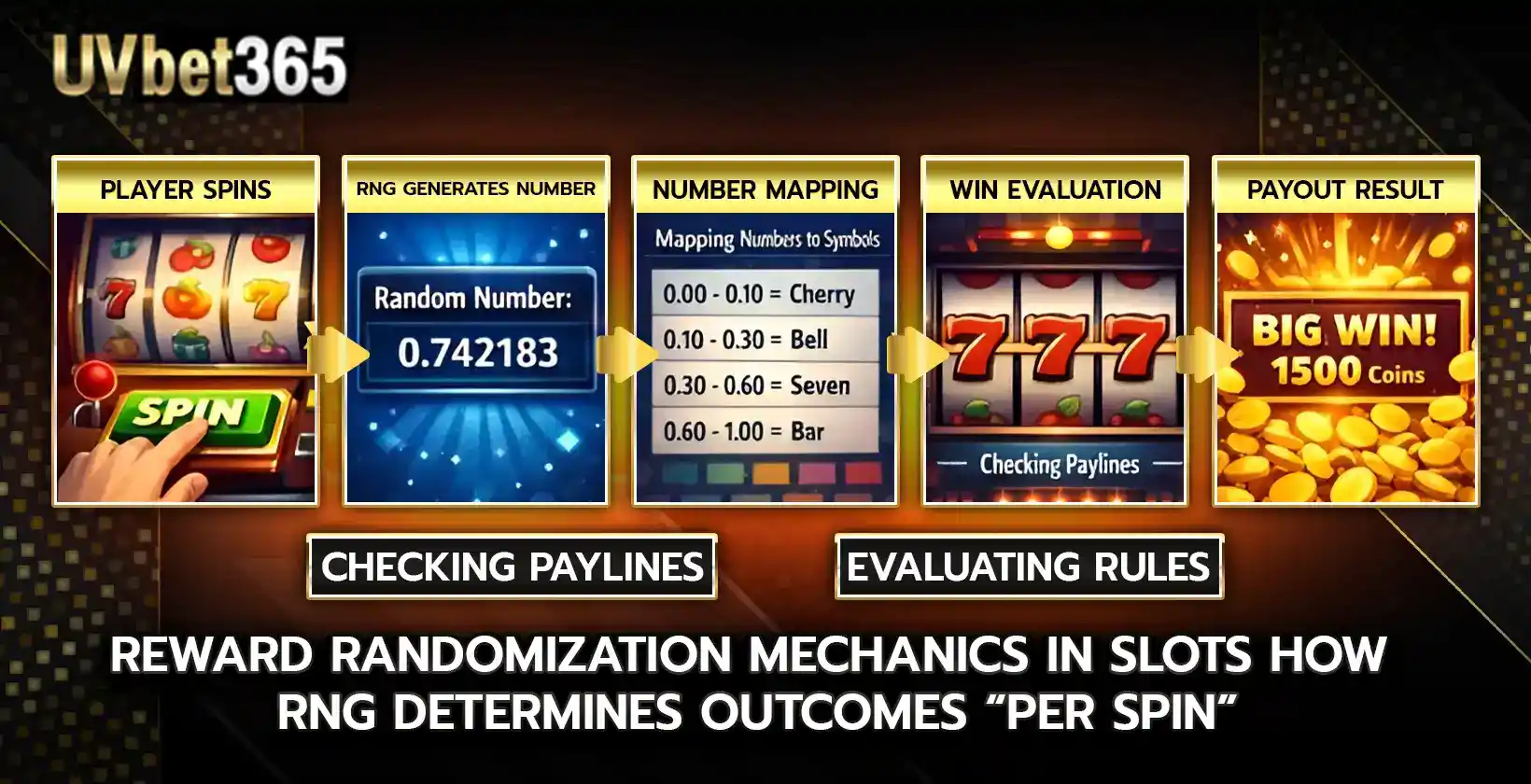
The outcome of Slots is set by a “random number” generated on the backend—not by the on-screen animation you watch. If you want to understand how one spin of Slots is processed, think of it as a single flow that always runs in the same order:
RNG generates a value → Mapping builds what appears on the grid → Evaluation checks win conditions → Payout calculates the winnings.
The core of “fairness” sits in backend logic that uses the random value as input and settles results with a repeatable rule set, not through visual speed or animation timing.
This article explains the backend mechanics used by most Online Casino platforms, focusing on per-spin logic so you can separate what is truly random from what is rule-based calculation.
RNG — The Random Core That Starts Every Outcome In Slots

If you ask, “How do Slots randomize?” In an Online Casino, the backend answer is simple: it starts with RNG (Random Number Generator). RNG produces the value used as the “starting point” for each calculation. In practical terms, the game needs a value that is hard to predict, and then it interprets that value into what will be shown for that spin. Without a random source, there is no suitable input to define outcomes in a consistent, rules-driven way.
In practice, many Slots use PRNG (Pseudo-Random Number Generator), a common approach found in both casino reel games and Slot Game titles because it can be controlled and tested for randomness quality. Two terms often mentioned together are seed/state:
- Seed is the starting value that begins the number sequence.
- State is the internal status of the generator that changes whenever a new value is produced.
In short: the seed is the “starting point” of the number sequence, while state is the “continuously changing status” on each draw—so the next spin does not repeat the previous one and does not rely on feelings or prior outcomes.
The point of seed/state is not memorizing terminology, but understanding that “randomness” in this gameis backend work with an ordered structure—not something created by watching animations or thinking “it should hit soon.”
Another key misconception this clears up is that what you see moving on-screen is not what decides settlement. The motion is UI/animation, but the value used to settle the result is chosen at the start in the logic layer. After that, the generated value is handed off to the mapping layer to determine what actually appears.
What makes the result “fair” (mechanically) is usually tied to checkable conditions, such as:
- The randomizer should pass statistical tests showing the number distribution is sufficiently uniform at the required level, and
- The calculation must be separated from UI (same displayed layout -> processed under the same rule set -> settled according to the paytable).
This keeps outcomes dependent on “input + rules,” not on animation timing or the previous spin.
Mapping — Turning “Random Numbers” Into What Appears In Slots

After the random value is generated, the game does not immediately conclude what symbols show up, because the value is only an abstract number. It must be translated into a tangible display—such as stop positions and the symbol layout that will be shown.
What Is Mapping In A Slot System, And How Does It Convert Random Numbers Into Reel Results?
Mapping links the RNG value to the symbol structure of reel-based games, often explained using terms like reel strip / virtual reel. In a simple, backend-readable sequence, it works like this:
- On the backend, there is a “position list” for each column (a long list) that specifies which symbol sits at each position.
- The value is converted into an index/position on that list.
- Once each stop point is determined, those positions are assembled into the final display.
In many Online Slots Games and Casino Slots, the symbol structure is designed to support weighting (uneven frequency). That means symbols are not placed in equal counts in the underlying list. Some symbols occupy more positions and therefore have a higher chance to be selected, while others occupy fewer positions and are harder to land. This is the source of probability at the backend level—not the animation you see on-screen.
Having weighting does not mean the game is cheating. It is a way to “design probability” to match the paytable, balancing hit frequency with overall reward size over the long run
So what you see moving should be treated as “display,” while the settled outcome is determined on the backend through this mapping pass.
Evaluation — Checking “Win / No Win” from the Converted Display
After mapping finalizes the layout for that spin, the stage that makes settlement the clearest is Evaluation, because this is where the displayed layout is compared directly against the game’s win rules..
If you have ever wondered How Do Slots Work in the sense of “what does the game actually settle from?”, the answer is here: it acts like a rules-check engine—
Displayed Symbols + Game Rules = Settlement Decision.
In an Online Casino, the logic-based fairness principle is that if the data is the same (same layout, same rules), the decision must be the same—independent of effects and not dependent on the previous spin.
Common win models include:
- Paylines: checking along predefined lines
- Ways: counting winning ways based on defined directions/conditions
This also includes rule-based special symbols in Slot Game such as Wild, Scatter, and Bonus, which are “additional rules” for condition checking—not a hidden trick.
Payout — Calculating Winnings from the Evaluation Decision
Once Evaluation confirms “what wins occurred,” the final step is Payout—turning the win decision into a “winnings number” in a systematic way.
Payout mainly refers to two parts:
- The game’s paytable
- Related conditions such as multipliers or rules for combining multiple wins
The calculation flow is:
base payout (paytable) -> adjust by conditions -> summarize the payout for that single result
There is no extra randomness added here, because randomness ends once the display is fixed.
In Casino Slots and Slot Game on Online Gambling Sites, the Payout step is also tied to settlement for recording outcomes and updating balances consistently with the inputs used for calculation:
- Input: displayed layout + rules/conditions + paytable
- Output: the winnings amount
Summary
The backend core of Slots in one spin is:
- Generate a value -> translate it into what appears on the grid,
- Check win conditions by the rules,
- Calculate winnings by the paytable.
This is the mechanical reason a game can be considered “fair” under defined rules: outcomes are settled from clear inputs and unchanged logic under identical conditions, not from visuals or feelings. This content is system-level knowledge to understand the mechanism, not a Bet Game trick and not practical guidance for entering Online Betting Games.