




Cricket odds have changed more frequently and at a noticeably faster pace since the International Cricket Council (ICC) permanently enforced the Stop Clock rule. This regulation requires teams to begin each over within a limited time, allowing matches to flow more continuously and reducing long periods of inactive play.
As the pace of the sport increases, key on-field events such as losing a wicket or scoring runs in quick succession, now occur within much shorter timeframes. This causes cricket odds on betting boards to adjust immediately in response to live situations. Instead of changing at wider intervals, as in previous formats, quotes now move more frequently and follow the real rhythm of the match more closely.
Under this rule, the fielding side must be ready to start the next over within 60 seconds after the previous over ends. If the requirement is not met, the team enters a warning process followed by penalties defined by the regulation.
The impact of the Stop Clock rule goes beyond what happens on the field. It directly affects price movement in the online sports betting environment, where betting activity must react to the contest situations in real time. Those who follow cricket odds therefore need to understand how timing in a match influences the movement of Decimal quotes.
What Is The Icc Stop Clock Rule, And Why Does It Affect Cricket Odds?
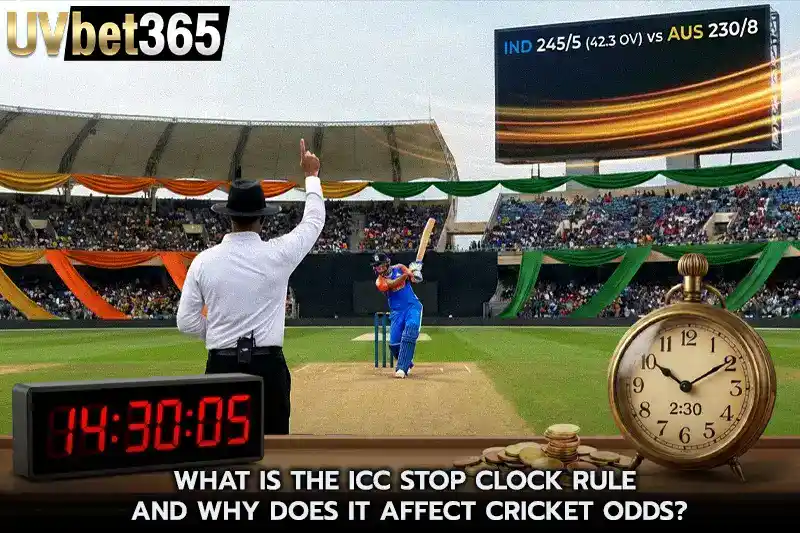
The Stop Clock rule was introduced to control time management in the sport competitions. It requires the fielding team to be ready to begin the next over within 60 seconds after the previous over concludes. Teams are allowed two warnings, and if the rule is violated again, an immediate five-run penalty is applied.
The main objective of this rule is to keep matches continuous, reduce periods when play becomes inactive, and align the format of the game more closely with live broadcasting. When the time structure on the field changes, the movement of cricket odds must respond to on-field situations in a much tighter timeframe than under previous formats.
The Time Restriction for Starting Overs Under the New Rule
The core principle of the Stop Clock rule is to enforce a clearly defined time limit for starting each over. This regulation helps reduce unnecessary delays and allows matches to progress more continuously in cricket. As a result, the rhythm of the game becomes more consistent, and on-field events occur in steady succession without the long pauses seen in the past.
The Stop Clock countdown begins immediately after the previous over ends, requiring the fielding team to be ready to start the next over within the allotted time. This prevents play from being extended unnecessarily.
With this level of time continuity, evaluating game situations now depends increasingly on timing rather than waiting for isolated key moments.
Faster Match Pace Leads to More Frequent Key Events
When the time allocated to each over is strictly controlled, important on-field events occur within shorter intervals. Whether it is the loss of a wicket or rapid scoring, the state of an event match can change quickly within just a few minutes.
As a result, cricket odds must move almost immediately in response to these developments. Periods when prices remain stable become shorter, and price changes occur more frequently than under traditional event formats.
When the pace increases, every on-field event immediately influences how the contest is evaluated.
How The Faster Pace Under The Stop Clock Rule Affects Cricket Odds

Since the ICC permanently enforced the Stop Clock rule, the most visible change has been tighter control over time in matches. Shorter gaps between overs allow the game to continue without interruption and directly affect how situations are evaluated in the cricket betting market, where wagering decisions depend on real-time developments.
This change means that cricket odds no longer move at spaced intervals. Instead, prices adjust continuously in line with the faster rhythm of the game. This creates a clear link between the contest regulations and the movement of market numbers.
Why Prices Move More Frequently When Match Time Becomes Tighter
When play time is compressed, events on the field affect the situation immediately. The relationship between on-field events and market rates becomes more visible, especially in sports market quotes , which are based primarily on the current state of play.
Common examples include:
- Consecutive wickets falling within a short period
- Rapid scoring within a single over
- Sudden shifts in the contest momentum
These situations force cricket odds to adjust instantly to reflect new probabilities. This behavior is characteristic of online bet cricket in faster match formats and modern betting conditions.
Shorter Periods of Stable Prices in Faster Match Formats
Under the Stop Clock rule, periods when no major events occur become noticeably shorter. Long stretches of stable rates that once appeared in live markets are now rare. On cricket betting websites, prices may change immediately after only a few deliveries.
As a result, prices move with greater continuity and require close attention to both match timing and numerical changes. Following live prices now depends increasingly on reading the timing of the sport alongside the movement of numbers, rather than focusing on a single price point in betting environments.
Reading Sports Prices in Decimal Format on uvbet365
Changes in game structure under the Stop Clock rule mean that reading market valuations now requires more than simply looking at figures. In live markets where values move in real time, understanding the structure of Decimal pricing helps provide a clearer picture of how play unfolds, without relying on calculations or betting strategies.
Within the context of cricket betting, Quote figures reflect the condition of the game at a specific moment. The faster the pace of play, the more frequently prices adjust to reflect the tempo of match and betting evaluation.
Keeping Up With Moving Decimal Quote on the uvbet365 Board
On the uvbet365 live market board, prices are continuously updated based on events on the field. As games accelerate under the Stop Clock rule, reading Decimal pricing requires attention beyond the number shown at a single moment.
Key elements to observe include:
- The market name and selected side, aligned with the current game situation
- The frequency of quote changes, which often increases during over transitions or after key events
- Brief moments when market values pause before continuing to move with the rhythm of the game.
This approach helps provide a clearer overview of play by considering both numbers and timing together, without the need for additional betting calculations.
Decimal Numbers Reflect Match Probability at That Moment
Decimal numbers are a numerical format used to represent the probability of match outcomes at a given moment. These figures are based on real conditions on the field, such as remaining overs, current scores, and recent key events.
In cricket betting odds, these numbers are not fixed. They change continuously as the match is reassessed. Followers of cricket can therefore use decimal numbers as a reflection of match momentum without analyzing complex betting formulas.
Faster Match Formats Lead to More Frequent Numbers Adjustments
As the pace of events becomes tighter, events occur more frequently and in closer succession. This causes market values to adjust rapidly, with prices sometimes changing several times within a short period.
For those who closely follow cricket odds, observing how frequently prices move alongside the timing of events provides better insight than viewing pricing as isolated numbers in betting analysis.
Reading cricket odds requires attention to both numbers and timing at the same time.
Real Match Examples Where New Rules Trigger Immediate Odds Changes
Under the Stop Clock regulation enforced by the ICC, matches have become noticeably more time-sensitive. Events that were once spread out now occur closer together, causing live market prices to adjust almost immediately rather than waiting for natural breaks in play.
The following examples illustrate how pricing dynamics move in faster competitive game environments.
A Real Case — USA vs India at the 2024 T20 World Cup
During the 2024 T20 World Cup contest between USA and India, the USA team received a five-run penalty after exceeding the allowed number of Stop Clock warnings. The incident occurred in the middle of the innings, a phase where the state of the match could still change.
When the penalty was applied, the game situation shifted instantly. This forced live markets to reassess probabilities without delay, and prices moved in direct response rather than waiting for a pause in play.
This case clearly shows how, under the Stop Clock regulation, even small changes in game conditions can immediately affect price movement in betting markets.
Faster Over Transitions and Live Market Price Movement
When the start of each over is strictly timed, traditional resting points between overs become much shorter. Periods when market values remain stable during over changes are now uncommon.
In real situations:
- Live market prices may begin to move before the previous over fully ends
- Match evaluation adjusts continuously as soon as the next over begins
- Events prices move in line with the game’s rhythm without interruption.
This makes price movement tighter in time and clearer to those closely tracking the game and betting activity.
Key On-Field Events That Drive Price Movement Under Current Rules
In faster matches, key events may occur close together within a short timeframe, such as:
- A wicket followed by a boundary in the next over
- Continuous scoring while the fielding side is still adjusting
When these occurrences happen close together, live odds adjust immediately to reflect the new match situation. The increased pace of events causes prices to flow more continuously, with changes sometimes occurring within just a few deliveries.
These situations highlight that under current regulation, following cricket betting odds requires attention to both on-field occurrences and timing, rather than viewing prices at a single moment.
Summary
Betting odds have become more frequent and faster since the ICC permanently enforced the Stop Clock rule. The regulation has made events matches more continuous and significantly reduced periods when play is inactive.
As time on the field becomes tighter, key occurrences occur more often, requiring betting prices to adjust in real time. Those looking for How to Read Cricket Odds When the Pace of the Game Speeds Up need to focus on the relationship between match timing and price movement, rather than on numbers alone.As game formats evolve and odds move more frequently, the common question of is cricket betting profitable cannot be answered by prices alone. It requires understanding the broader context of timing, momentum, and how match conditions change throughout the game.