



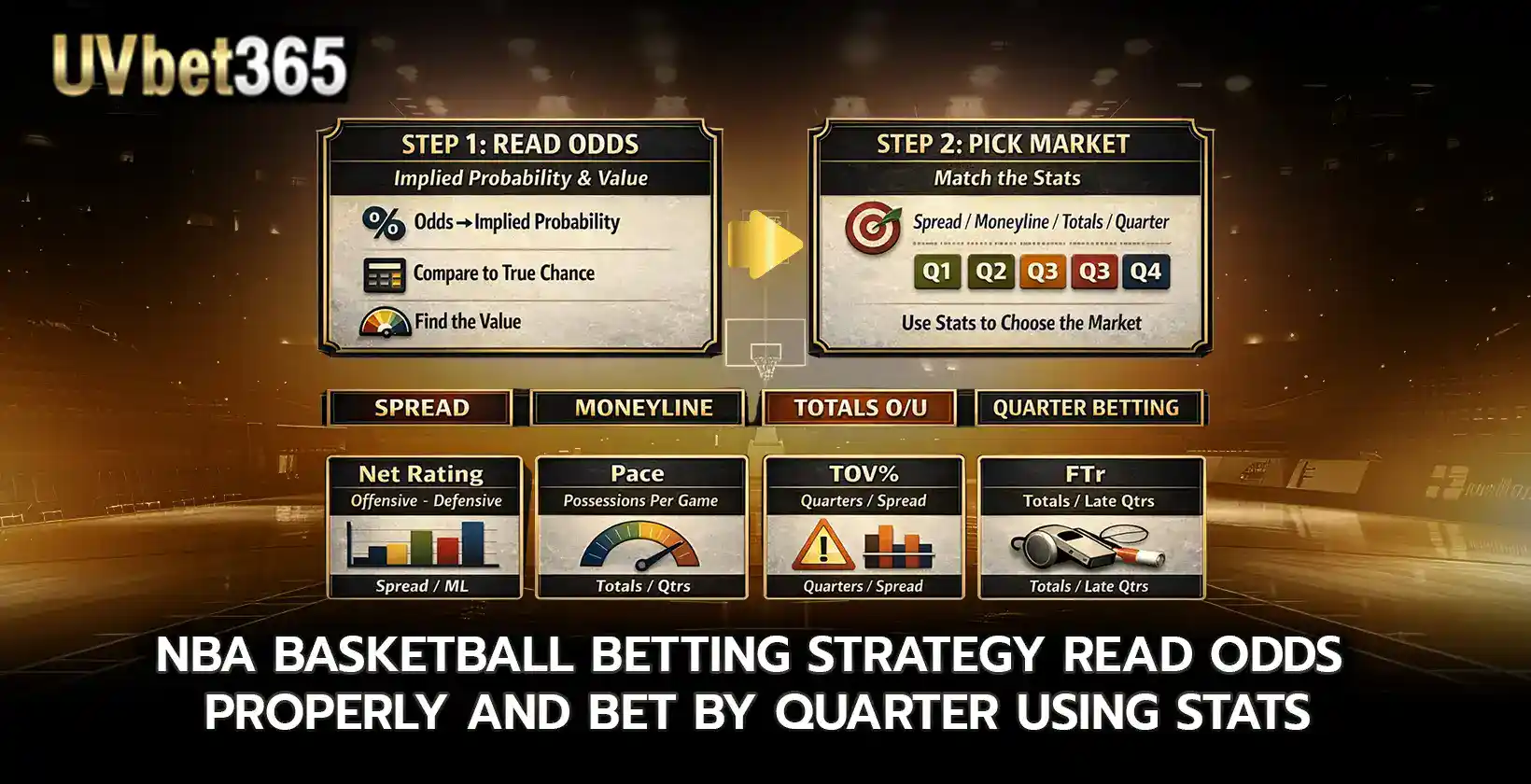
For NBA Basketball Betting, if you want to play with “numbers-based reasoning” rather than clicking on gut feel, start with these two things first:
- Read odds as “probability + value,” and
- Choose markets that match the data you actually have—whether it’s Spread, Moneyline,Q1–Q4 options, or Totals—using statistics such as scoring margin per 100 possessions, Pace, TOV% (turnover rate), and FTr (free-throw rate), along with home/away context and schedule fatigue.
This approach helps you make decisions that are measurable and reviewable rather than guess-based—an approach that fits anyone doing Basketball Betting who wants to be systematic and manage risk better, especially if you do Online Basketball Betting through Betting Sites Basketball (to check lines/prices) and then decide to confirm the ticket with Basketball Betting Sites in a way that’s “explainable” rather than emotional.
Read Nba Basketball Betting Odds As Numbers Before Choosing A Side
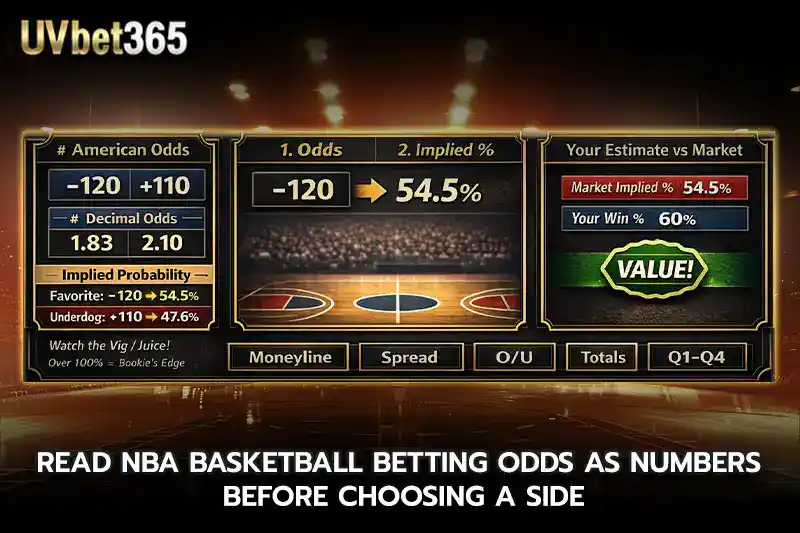
In the NBA, odds don’t only mean expensive or cheap. They represent the chance reflected by the market plus a hidden cost (Vig/Juice). If you don’t translate the quoted price into numbers, you may drift toward favorites or hype and lose to market costs over the long run. Converting the price into probability is the foundation of long-term +EV Basketball Betting, and it’s a How To Bet On Basketball approach that lets you review your reasoning every time—especially when placing selections Bet Online.
The short but complete method
1) Convert odds into Implied Probability
A simple rule of thumb:
- Favorites usually imply a higher chance.
- Underdogs usually imply a lower chance.
Example: Decimal 1.90 → implied probability ≈ 52.6% (calculate 1 ÷ 1.90).
2) Find Value by comparing probabilities
If your estimated true probability is higher than the implied probability, value begins to appear. If it is lower, then even if you like the team, it is not worthwhile from a numerical perspective
Follow this principle consistently: How To Find Value Bets In Basketball Using Implied Probability
3) Check Line Movement
Line movement refers to price or line shifts caused by factors such as:
- Player news or injuries
- Schedule and fatigue
- Money flowing toward one side
Use line movement to read the pricing context and determine whether the market has already adjusted—not to predict results directly.
Practical psychology you can actually use
Popular teams and superstar names often attract one-sided public money, which can push the line too far. When you see a line move, do not automatically assume that the move is correct. Instead, ask:
- Did it move because of real news, or because of crowd momentum?
Bottom line: Line movement is for reading context, not forecasting outcomes..
Vig/Juice (one-line reminder)
Vig/Juice is the market’s built-in cost, meaning you must be more accurate than average to come out ahead. A quick way to spot it is that the implied probabilities of both sides often add up to more than 100%.
Play responsibly—only bet what you can afford to lose.
6 Stats To Read The Line And Pick The Right Market In The NBA
Before choosing Spread, Moneyline, Quarters, or Totals, remember this: each statistic serves a different purpose. Some show which team is stronger overall, some describe how fast and volatile the game may be, and others hint at whether the end of the game will slow down because of free throws. The goal is to use these six metrics as a translator—turning statistics into clear reasons why a matchup fits a specific market, instead of guessing based on intuition.
- Net Rating: point differential per 100 team possessions shows overall team strength.
Best for: Spread/Moneyline — it connects directly to win probability and expected margin. - Pace: possessions per game show how fast or slow the game is
Best for: Totals / Quarters — higher pace means more possessions, more scoring runs, and bigger swings. - TOV%: turnovers per possession indicate how mistake-prone and volatile a team is.
Best for: Spread/Moneyline/Quarters —turnovers can create quick momentum shifts, especially in shorter windows. - FTr: free-throw rate shows how often a team gets to the line and suggests a more stop-and-go rhythm
Best for: Spread/Totals —late-game free throws can extend scoring and affect both margin and totals. - ORtg / DRtg: offensive and defensive efficiency per 100 possessions measure scoring effectiveness and defensive control.
Best for: Totals — scoring is driven by possessions multiplied by efficiency, not just shooting variance. - OREB% (or OREB): offensive rebound rate shows how often a team gains second-chance opportunities.
Best for: Spread / Totals — extra possessions increase shot volume and influence momentum.
Quick memory hook:
- Net Rating = who’s better
- Pace = how fast
- ORtg/DRtg = how efficient
- TOV% = how volatile
- FTr = late-game free throws
- OREB% = extra shots
The Line Market Strategy In Basketball Betting: Use The Gap Between The Line And The Team’s True Level
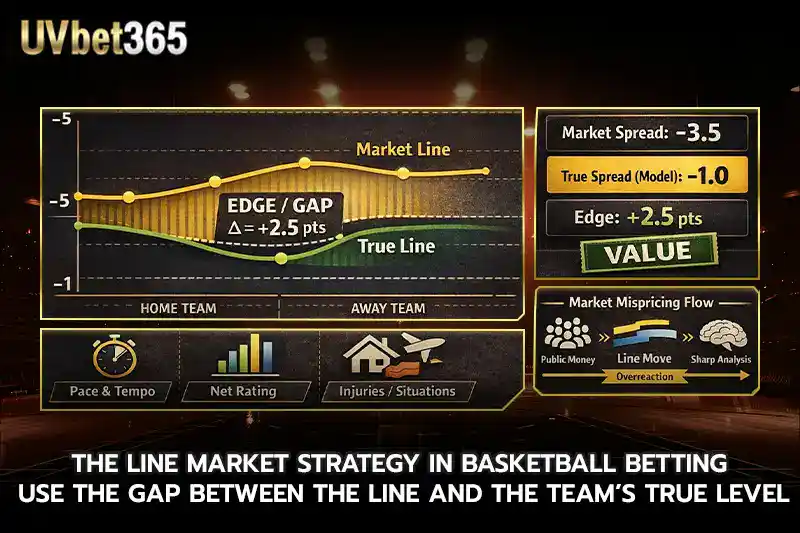
The core idea behind the line is not simply predicting who wins, but whether a team wins or loses relative to the line. The sharper approach is to find value where the price doesn’t yet fully reflect reality—meaning in the Basketball Betting line market you’re playing the “margin,” not the team name. When comparing lines on Betting Sites Basketball, focus on the reason behind the margin first.
What is a Spread?
- Favorite: Must win by more than the listed line to win the bet
- Underdog: Could lose within the spread and still win the bet
How accurate do you need to be?
For many two-way spread prices, the required cover rate sits in the low-to-mid 50% range once vig/juice is included.
Think sharper: only these 5 factors matter
- Net Rating
- Tempo (a faster pace increases score swings and volatility)
- TOV% (more turnovers mean gifting possessions and points)
- FTr (more free throws late in the game can stretch margins)
- OREB ((second chances create extra scoring opportunities)
When to use and who it fits
- When matchup, team condition, or schedule creates an edge that appears as a reasonable point margin
- For people who accept that basketball margins swing in runs and prefer data-driven decisions over intuition
Quick checklist before clicking
- Did the line move because of real starter or minute news, or just public money and hype?
- Is the pace high? If so, score swings are larger—be cautious about momentum runs.
- Is late-game scoring at the free-throw line likely to be high? (It can either preserve or break the cover.)
Moneyline Strategy: Win Only, But It Must Be Worth the Price and Risk Must Be Managed
A Moneyline bet is a simple win/lose wager—if your team wins, you win, with no spread involved. It is most suitable when matchups are close or when margins are volatile enough to make spreads risky. The key condition is “value versus price,” because prices are often expensive and a single loss can have a larger impact. This is a common trap in Basketball Betting, especially in Online Basketball Betting where many people choose Moneyline through Basketball Betting Sites and make decisions as Online Gambling, so the math must be tight.
How accurate do you need to be? (Instant Clarity)
- Price 1.50 requires about 66.7% wins (roughly 2 out of 3)
- Price 1.30 requires about 76.9% wins (roughly 3 out of 4)
“One loss hurts” in measurable terms
At 1.30, profit per win is 0.30x stake, so one loss often requires about 3–4 wins just to get back to even.
How to select Moneyline positions more precisely (three axes only)
- Convert price to probability first (Implied Probability)
- Favor teams that control possessions (low TOV%)
- Look for measurable closing signals, such as clean ball control and a tendency to earn late free-throw attempts
Traps you must cut fast
- Expensive prices magnify the impact of a single loss—do not accept them without clear value
- Never decide based on “they shouldn’t lose.” Always compare your estimated win probability with the listed price
Quarter Markets (Q1–Q4) Read the Action in Segments Using Stats and Rotations
Quarter markets divide a matchup into Q1–Q4 (or first half and second half). You can target the result of a specific period, a mini-spread, or a mini-total. The advantage is that NBA strengths often appear in particular stretches because of rotations and bench units, making certain windows more targetable than the full-game line.
Many people use this to “increase value and reduce guessing” in Basketball Betting once they understand a team’s patterns. When comparing Q1–Q4 prices on Betting Sites Basketball (or compare prices via Basketball Betting Sites), the key is to find a segment-based edge rather than guessing the entire outcome, Even if you’ve done Tennis Betting before, the idea of “reading momentum in phases” still helps you see the match in a similar way.
The practical target
Most quarter lines behave like other two-way markets: over time, you aim to exceed the low-50% accuracy threshold using measurable patterns rather than luck.
A simple framework
- Bench impact: When starters sit, momentum can flip quickly (often affecting Q2 and Q4)
- Q1 vs. Q3 profile: The opening stretch versus the start after halftime (adjustments and energy after the break)
- Early foul calls and early-possession miscues: Quick whistles can stabilize play, while sloppy sequences create swings and fast runs.
A simple selection rule
- Starter-driven edge: Focus on Q1 or the first half
- Bench-driven edge: Focus on Q2 or Q4
Totals (Full Matchup And Quarters): Use Possession Frequency Plus Efficiency Instead Of Guessing Whether Shots Will Fall
Totals are bets on whether the combined score finishes over or under the listed line (full matchup, half, or quarter). A sharper framework is to focus on two axes: possession volume and scoring efficiency. Total points come from how many scoring opportunities exist and how efficiently those opportunities convert—not from guessing whether shots will fall on a given day. This market is especially useful when it is difficult to pick a winner but easier to read the likely scoring pattern especially for Online Basketball Betting players who like analyzing pace, matchups, and shot profiles. Even if you’ve followed markets like Virtual Sports Betting before, NBA totals still ultimately come down to possessions and efficiency.
Analysis axes
- Possession rate (Pace): estimated number of possessions
- Efficiency: ORtg/DRtg (offensive and defensive efficiency)
3 variables that commonly make Totals miss
- Free-throw volume: frequent trips to the line can raise scoring even in a slow-tempo game
- Turnovers: more empty possessions reduce shot opportunities, which can lower scoring
- Three-point variance: heavy three-point volume increases volatility (hot shooting raises totals, cold shooting lowers them)
Avoid common mistakes
- A fast pace does not automatically mean Over if efficiency is low or turnovers are high.
- A slow pace does not automatically mean Under if free-throw scoring is high and efficiency is strong.
Psychology and Home/Away Splits: Convert Motivation and Fatigue Into Usable Numbers
If you want to use home/away and fatigue properly, stop guessing and check three things before tip-off:
- Home/away form adjusted for opponent quality
- Schedule and travel load, and
- Variables that often change when a team is tired—such as pace, ball security, and foul-shot volume—then link those impacts back to the market.
This approach helps long-term Basketball Betting players stop being pulled by team names and return to real numbers before deciding on Betting Sites.
Home/Away split (do not rely only on wins and losses)
- Check whether home/away conditions truly change performance, and compare opponent quality as well
- Focus on usable metrics such as average margin differences or turnover gaps between home and away games
Back-to-back, Rest days, and Travel
- Review back-to-back situations, tight schedules, long travel or time-zone changes, and the end of road trips
- Common signals include reduced pace, sloppier possessions, and increased volatility
Link the impact back to the market
- Slower pace, stalled offense, or frequent empty possessions often affect totals and sometimes by-quarter lines
- Increased mistakes and volatility require extra caution with spreads
- Expensive favorites in fatigue situations warrant caution with Moneyline positions because upset risk can rise.
30-second checklist
- Is this a back-to-back, tight schedule, heavy travel, or end-of-trip situation?
- Is the home/away split poor because of opponent quality, or is performance genuinely weaker?
- Which variable is most affected: pace, ball security, or free-throw scoring?
- Choose the market that matches the impact: totals or Q1–Q4 (segments), spread (margin), or Moneyline (upset risk)
Summary
In Basketball Betting, if you want to choose the right market without guessing, start with the matchup’s strongest data signal. If one team has a clear efficiency edge and the matchup supports a reasonable margin, lean toward the spread. If you believe a team is likely to win but the margin is volatile or the matchup is tight enough to make spreads risky, lean toward the Moneyline.
If the edge appears in specific stretches due to starting units, rotations, or bench patterns, consider Q1–Q4 lines. If possessions and efficiency point clearly in one direction and you can read the likely scoring script, focus on totals. Then use fatigue signals (back-to-back games or travel) as fine-tuning factors by checking how they affect tempo, ball security, and whistle-driven scoring—often influencing totals and Q1–Q4 markets first.
This keeps you from choosing the wrong market axis and makes every decision reviewable—and that’s Betting based on data, not emotion.
Note: Betting involves risk. Set a budget and limits, and play responsibly.