



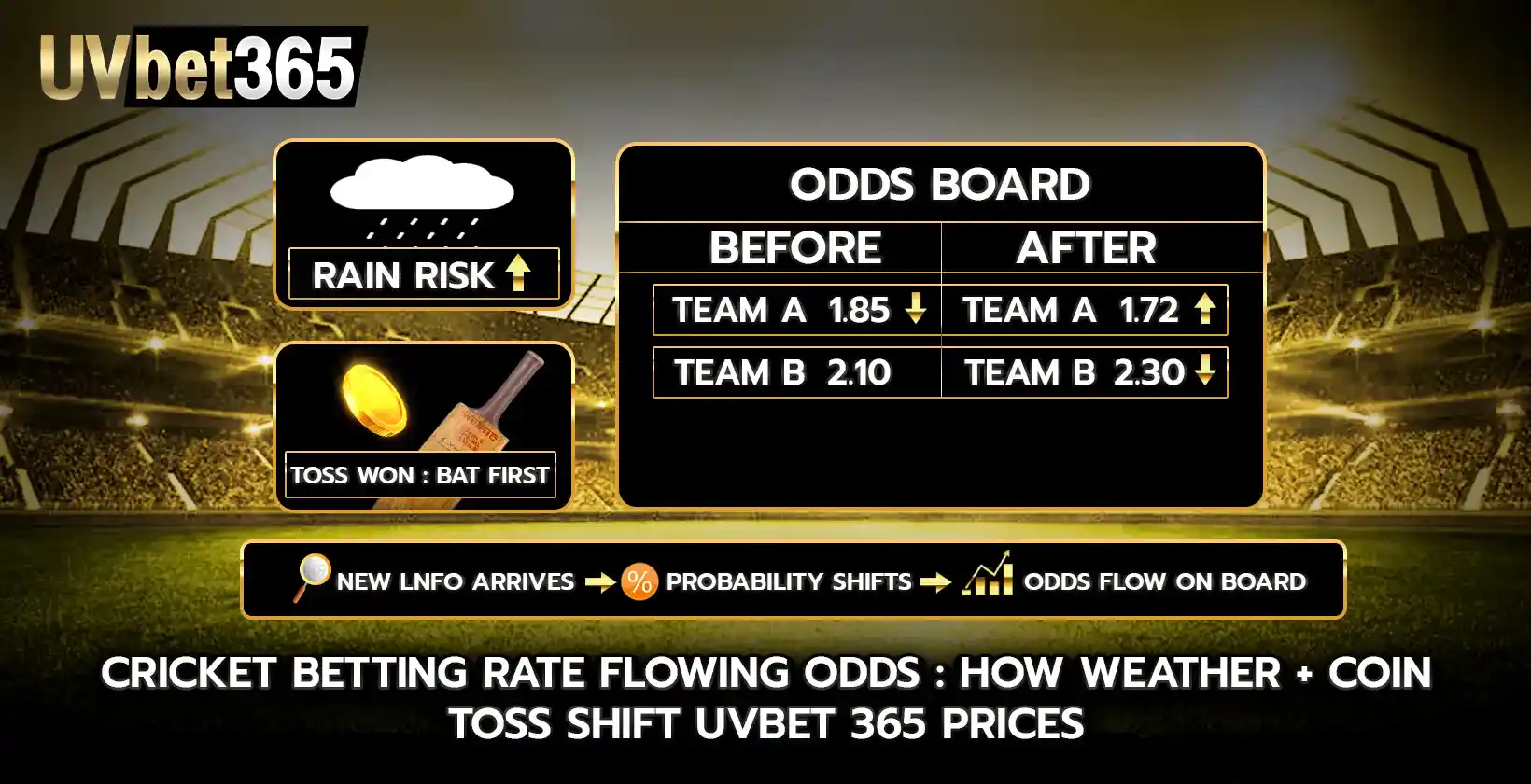
A cricket betting rate “flow” refers to how the odds on the board keep updating when new, verified information changes the match’s pre-match conditions. The platform must keep the displayed rate aligned with implied win probability and the actual risk reflected by the latest updates. When fresh information arrives, the previous figure is continuously updated on the uvbet365 board. The clearest window for this is usually before the match starts—especially once the latest prediction is confirmed and the coin-toss result is announced.
If you’re wondering Why do betting odds of cricket keep changing before the match starts? The short answer is that verified information keeps arriving, so the system must adjust the implied probability quickly to stay current. In this article, we focus on only two variables—weather forecast and the toss result—to make the logic clear before you decide on online cricket betting or observe the pricing system in a sports gambling game without guessing.
This article explains where pricing system movement comes from and why it flows, focusing exclusively on forecast update and the coin-toss result (without diving into match rules), so you can understand the listed price systematically—ideal for people in betting who want to read display movement with reasoning.
Where Does The “Opening Quote” Of Cricket Betting Rate Come From
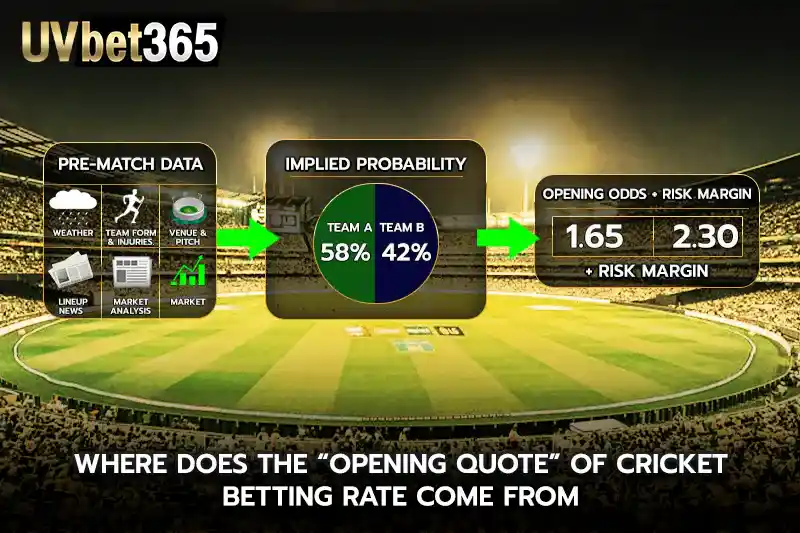
Before a market can “flow,” it needs a starting point. Think of it as:
Opening quote = initial probability (before verified information) + a risk buffer
This first figure acts like a baseline, so the pricing system screens to begin trading immediately and then adjust as real information arrives and gets confirmed. That’s why the market price doesn’t lag behind changing situations.
Put simply, the opener is the reference point used to measure how much new information shifts the likelihood of outcomes. Without that baseline, there is no clean way to update systematically.
Technical Structure of the Opening Quote
- Implied Chance: The displayed figure communicates how the chance of an outcome is being assessed (it’s not random).
- Overround / margin: Pricing systems usually include a built-in cushion to absorb information volatility. This explanation is provided to clarify the logic, not to teach profit or loss calculation.
Why the opener is not the “final number”
The market is designed to recalculate whenever information affecting pre-match conditions arrives—such as shifts predictions or a confirmed toss result. The screen can stay synced with the latest condition of cricket betting rate.
How Does the “Flow” Mechanism Work on uvbet365
To picture How Does Cricket Betting Odds Work, keep this simple sequence in mind:
1) Event Information
2) Probability Updates
3) Board figure updates
4) Display on the screen
That’s the basic structure behind the cricket betting rate you see changing on screen.
Core Update Sequence
- Receive event information (such as forecast updates / the coin-toss announcement)
- Update implied likelihood to match the new situation
- Adjust the displayed figure to reflect the latest risk
- Publish the refreshed number on the market screen
Why Movement Speeds Up at Certain Moments
Board changes appear “faster” when incoming information has two features at once:
- High impact on pre-match situation (it meaningfully changes uncertainty)
- Fast confirmation (it’s not vague or speculative)
In this article, we focus on two common accelerators with clear impact: the latest forecast and the coin-toss result.
The Idea of Volatility (in Simple Terms)
When uncertainty is high, the market refreshes more frequently to stay aligned with real situations. That’s why the market place can look like it updates more often than usual right before a cricket game starts.
How Weather Outlook Make Cricket Betting Rate Flow
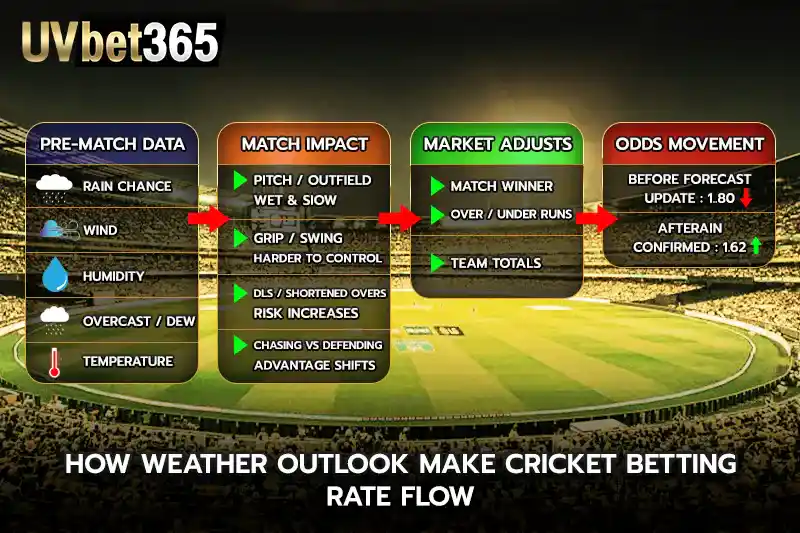
Conditions matter because they change uncertainty—and uncertainty is what the market must reflect through the number shown on the pricing screen. When uncertainty rises or falls, the rate must adjust with it.
Where Weather Report Change Pre-Match Risk
- Rain / interruption risk: Increases uncertainty around start time and continuity, so the market embeds more risk into the displayed figure
- Humidity / dew / wind: Shifts the playing environment in a situation-specific way (mentioned here only as condition-driven effects, not as a full pitch analysis)
Translating Forecast Updates into Flow Logic
The logic is straightforward:
Condition signals → risk changes → probability shifts → board updates
When Conditions Move the Price Screen the Most
- Close to start time when an updated prediction arrives
- When situations shift suddenly near the start (new info arrives fast and carries meaningful weight)
Table: forecast signals → Why the Price Screen Must Update
| Signal (Forecast) | Logic That Triggers Movement |
| Rain chance rises / rain starts near match time | Uncertainty rises → probability updates → cricket betting rate adjusts |
| Latest forecast differs from expectation | New information outweighs old → price screen refreshes to reflect current risk |
| Wind / humidity shifts clearly | Situational environment changes → probability updates → display updates |
Scenario example
- Pre-match: The screen sits around the baseline.
- Latest forecast update: Uncertainty changes.
- Board outcome: The displayed figure refreshes to match the latest situation.
(This is what people playing bet game online often notice before deciding. For anyone involved in bets, anchoring decisions to reasons, rather than emotions, leads to clearer reading of price movement.)
How The Toss Can Change Cricket Betting Rate Immediately
The coin-toss result drives sharp movement because it’s confirmed information, not a prediction. Once announced, the market can update estimated probability immediately—this is why many people in a cricket wagering game notice the screen jump right after the announcement.
The Toss Result is Confirmed Information
The Toss matters because it is real, clear, and announced publicly. It removes part of the uncertainty or redirects it into a newly confirmed condition—which is why the pricing screen must refresh quickly.
Update Logic Right After the Announcement
- Before the announcement: The display reflects prediction likelihood with higher uncertainty still present.
- After the announcement: Confirmed information arrives, probability is recalculated and the display updates quickly.
When movement is clearest
- Before the announcement: The market is still waiting for confirmation
- After the announcement: Probability refreshes using real information and the board updates sharply.
Table: Coin-Toss Event → Why the Board Must Adjust
| Event (Toss Outcome) | Logic That Triggers Movement |
| About to be announced | Market still relies on forecasts → waiting for confirmation, so volatility can appear |
| Announced | Confirmed information arrives → probability is refreshed → cricket betting rate updates immediately |
| Announcement lands close to a forecast update | Back-to-back confirmation and uncertainty → more frequent refresh cycles |
Scenario Example (No Profit Calculation)
Before the announcement: Baseline remains, with some uncertainty still present.
After the announcement: Conditions are confirmed, situational probability refreshes, and the displayed figure updates.
Linking Forecast Information and the Toss Outcome to Flow by Separating Causes
If movement happens before the coin-toss announcement, what is it usually about?
It’s usually driven by the latest forecast signals or updates that change pre-match uncertainty, forcing the market to refresh cricket betting rate to fit current risk.
If movement happens immediately after the announcement, what does it usually reflect?
It typically reflects confirmed information from the coin-toss result. Once the outcome is known, implied probability shifts and the screen refreshes quickly.
If forecast and coin flip arrive close together, why does the board swing more frequently?
Because this is a window where new information arrives continuously—uncertainty shifts due to conditions, followed by confirmation from the toss—so the market refreshes more often to stay synced with reality. That’s why price-watching for online cricket betting becomes more driven by reasoning during this period.
Why uvbet365 Builds Trust Around Fast, Situation-Based Updates
Credibility isn’t about “numbers changing often.” It’s about changes happening for reasons, based on information that genuinely affects pre-match situations (in this article: expected conditions and the coin-toss result). A platform running a bet game should be judged by its update logic, not just the displayed figures.
Trust Principles Behind Flowing Numbers
When cricket betting rate refreshes in step with key events like conditions and coin-toss results, users can see that movement isn’t random—it’s reacting to risk-adjusted probability and the level of risk on the board.
No matter what kind of market you’re watching—such as back and lay in cricket betting—the key anchor is the same : board movement follows real-impact information and can refresh fast when needed.
What Users Should Expect From a Platform That Handles Flow Well
- Refresh the board when confirmed information arrives near real time
- Apply a concept-level approach to reducing mismatch during fast-changing windows (explained at a high level, without over-claiming internal system details)
Summary
A cricket betting rate that “flows” in fancy betting in cricket does so because the board must refresh to reflect changes in implied probability and risk. Within this article’s framework, the two variables that most clearly move the market before the match are anticipated conditions (which raises or lowers uncertainty) and the coin-toss result (which confirms key situations).Once this logic is understood, board movement can be read with clearer cause-and-effect—useful for people in Bets or anyone following sports markets who wants to track changes in step with events rather than reacting emotionally.